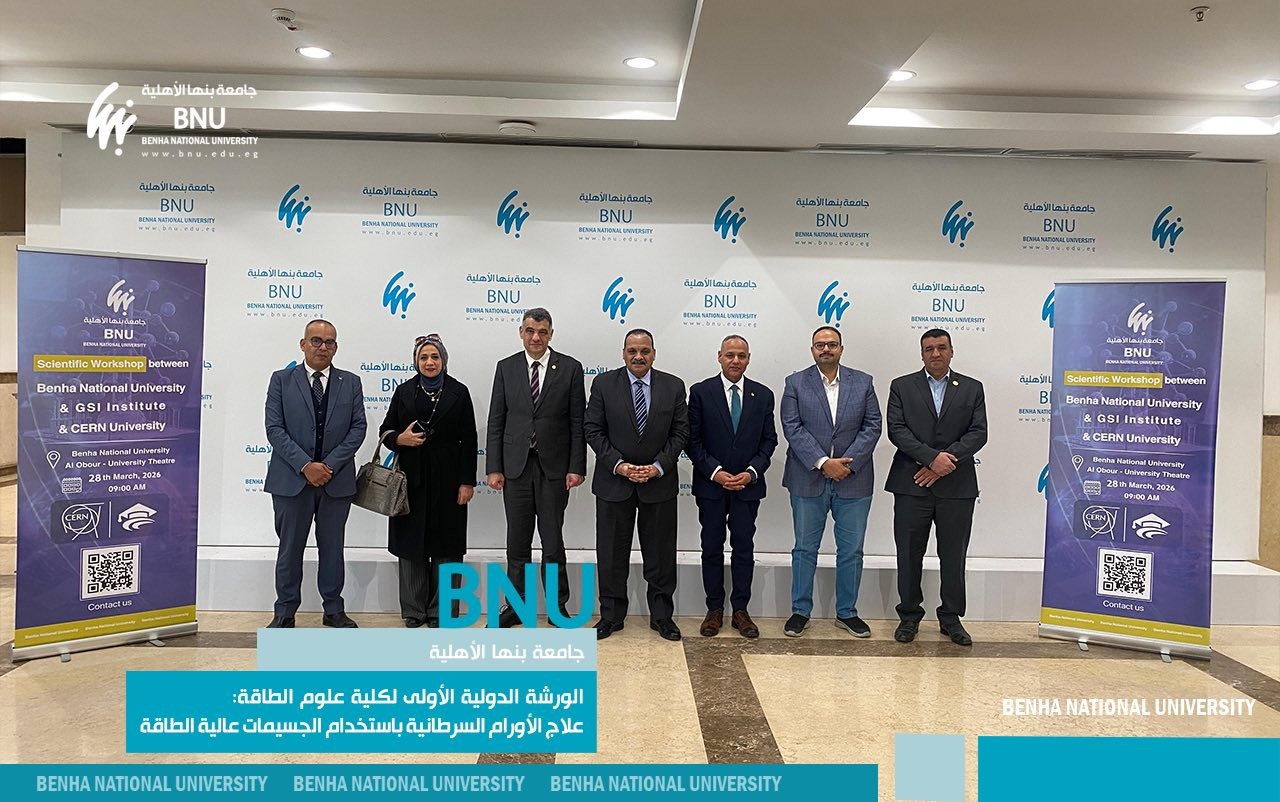
As part of its ongoing commitment to advancing scientific research and strengthening international collaboration in advanced medical fields, Benha National University organized the First International Workshop on Cancer Treatment Using High-Energy Particles, hosted by the Faculty of Energy Sciences in collaboration with GSI Helmholtz Centre for Heavy Ion Research (Germany) and CERN. The workshop reflects the University’s strategic commitment to engaging with cutting-edge global technologies in the field of cancer treatment and medical innovation.
The workshop was attended by:
- Dr. Tamer Samir, President of Benha National University
- Dr. Mahmoud Sakr, Advisor to the University for Scientific Research and Innovation
- Dr. Mohamed Mostafa, Director of the Energy Sciences Programs
Alongside a distinguished group of academic leaders, including:
- Dr. Mohamed Saeed, Engineering Advisor and Dean of the Faculty of Engineering at Shoubra
- Dr. Ashraf El-Meshad, Director of the Medicine Programs
- Dr. Ayman Samir, Director of the Veterinary Medicine Programs
In addition to leading experts from the National Cancer Institute:
- Dr. Mohamed Abdel Moaty, Professor of Oncology and Dean of the Institute
- Dr. Abeer Mostafa Ashmawy, Professor of Medical Biochemistry and Molecular Biology
- Dr. Samah Ali Lotfy, Professor of Virology and Immunology
Dr. Tamer Samir emphasized that the workshop reflects the University’s determination to remain aligned with global developments in oncology and cancer treatment, while providing an advanced educational environment that integrates academic knowledge with practical application. He noted that the University is committed to preparing highly qualified scientific talent capable of competing at both the regional and international levels.
Dr. Mahmoud Sakr described the workshop as a strong example of the integration between scientific research and applied practice, stressing that engaging students in advanced scientific experiences and exposing them to international expertise contributes to building a new generation of innovators capable of developing scientific solutions to pressing healthcare challenges. He also noted that Benha National University, despite its recent establishment, has successfully positioned research and innovation at the forefront of its institutional priorities.
Dr. Mohamed Abdel Moaty, Dean of the National Cancer Institute, expressed his appreciation for the collaboration with Benha National University and commended the scientific standard of the workshop. He highlighted the importance of such initiatives in preparing qualified professionals capable of contributing to the advancement of cancer treatment systems in Egypt in line with international standards, while also outlining the Institute’s role in delivering advanced therapeutic services and supporting oncology research.
Dr. Mohamed Mostafa explained that the workshop focused on one of the most advanced treatment modalities in modern oncology charged particle therapy. He noted that the training program was designed to provide students with a deeper understanding of contemporary clinical applications through the use of advanced simulation technologies.
The workshop agenda featured an intensive scientific program comprising a series of sessions on current developments in cancer treatment, including an overview of high energy particle therapy, the molecular foundations of cancer, the role of epigenetics in tumor response to radiotherapy, and discussions on the relationship between stress and cancer.
The workshop also included practical lectures and hands on training sessions on the use of advanced simulation tools in proton and carbon ion therapy through the matRad platform, in addition to interactive training activities. The program concluded with a video conference session that brought together students with international experts and peers from seven universities worldwide, providing a platform to present their work, discuss findings, and engage in interactive data analysis.
This workshop forms part of Benha National University’s broader strategy to advance applied scientific research, build impactful international partnerships, and contribute to the development of healthcare and cancer treatment approaches through the adoption of the latest global technologies.