
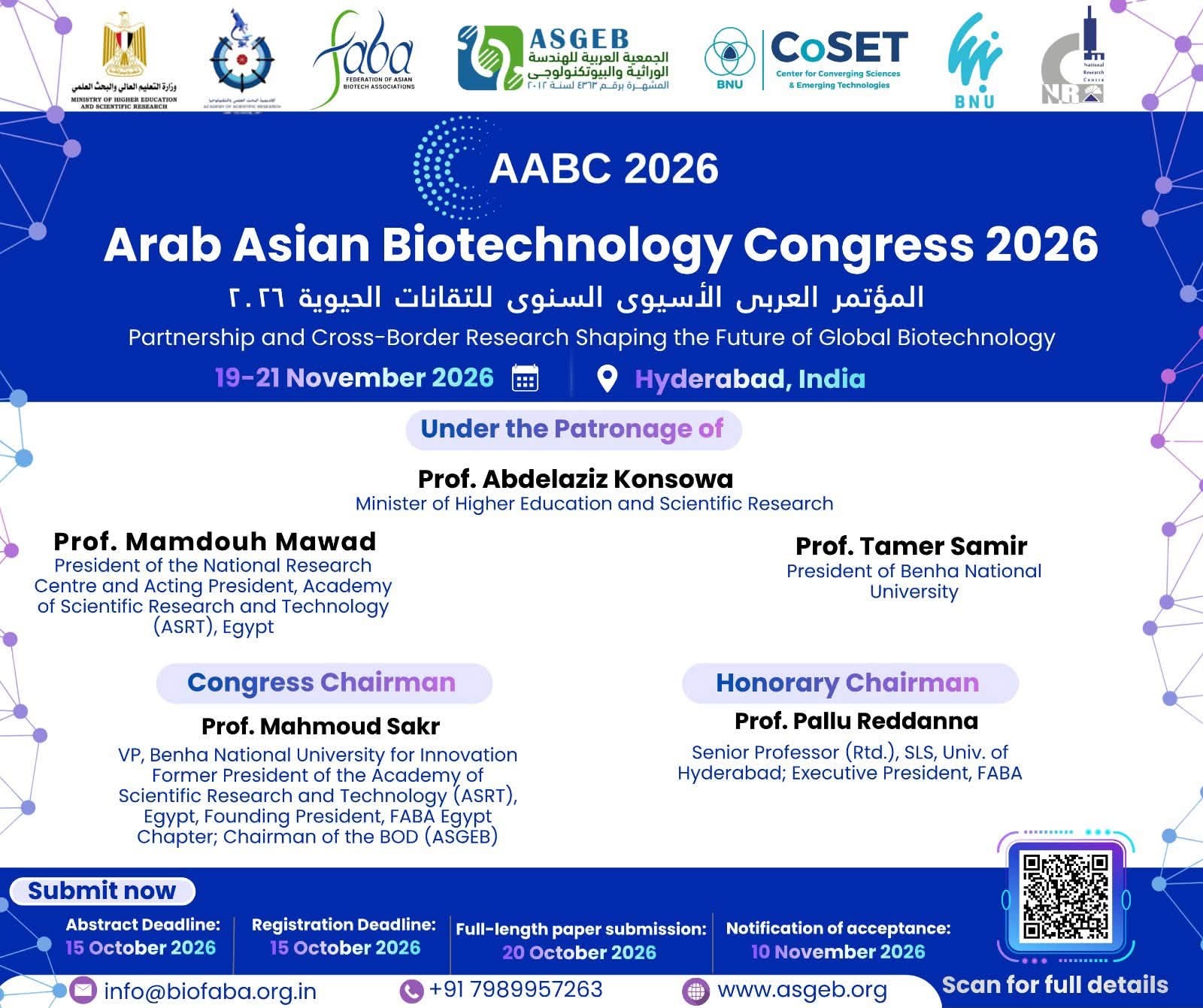
Prof. Gamal El-Saeed, Chair of Benha National University’s Board of Trustees, announced that the University, represented by its Center for Research, Development and Innovation in Converging Sciences and Emerging Technologies (CoSET), is taking part in organising the second edition of the Arab-Asian Biotechnology Conference (AABC 2026). The conference will be held in Hyderabad, India, from 19 to 21 November 2026, bringing together leading scientists, researchers, policymakers, representatives of universities and research institutions, industry leaders and innovators in biotechnology from Arab and Asian countries.
Prof. Gamal El-Saeed explained that the conference is organised by the Federation of Asian Biotechnology Associations (FABA) and the Arab Society for Genetic Engineering and Biotechnology (ASGEB), in collaboration with a number of leading Arab and Asian institutions. He noted that Benha National University’s participation in organising this international scientific event reflects its growing presence in international scientific and research cooperation and its role in supporting cross-border partnerships in advanced science and technology.
This year’s conference is held under the patronage of Prof. Abdelaziz Konsowa, Minister of Higher Education and Scientific Research; Prof. Mamdouh Moawad, President of the National Research Centre and Acting President of the Academy of Scientific Research and Technology; and Prof. Tamer Samir, President of Benha National University.
Prof. Tamer Samir, President of Benha National University, said that the University’s participation in AABC 2026 goes beyond its organisational contribution to include presenting aspects of its ongoing research. This reflects the University’s focus on maximising the benefits of scientific research and translating its outputs into innovative applications and solutions, while connecting scientific research with innovation, entrepreneurship and technology transfer.
He added that the University’s participation through CoSET provides opportunities to expand its network of international collaboration with universities, research institutions and industry, and to strengthen opportunities for cooperation in biotechnology and advanced sciences. This contributes to building research and innovation partnerships, while supporting pathways for technology transfer and commercialisation and the development of knowledge-based solutions.
Prof. Mahmoud Saqr, President of the Conference, Vice President of Benha National University for Employment, Innovation and Entrepreneurship, and Supervisor of the University’s CoSET Research Centre, and Dr Pallu Reddanna, CEO of the Federation of Asian Biotechnology Associations (FABA) and Honorary President of the Conference, explained that the second edition of the conference will address a wide range of advanced scientific and technological areas. These include genome editing and CRISPR technologies; AI-enabled biotechnology and bioinformatics; drug discovery; medical and pharmaceutical biotechnology; precision medicine; stem cell and gene therapies; as well as agricultural biotechnology, climate change, and industrial and environmental biotechnology.
The two Conference Presidents noted that AABC 2026 aims to move beyond the exchange of scientific knowledge and expertise towards building effective and sustainable partnerships among universities, research centres and industry. The conference will focus on supporting innovation and technology transfer, encouraging the establishment of biotechnology-based start-ups, and translating ideas and research outputs into practical solutions that are scalable and sustainable.
The second edition of the conference continues the journey that began with its inaugural edition, hosted by the Bibliotheca Alexandrina in Alexandria on 5 and 6 November 2025. The first edition brought together leading scientists, researchers, policymakers and experts in biotechnology from a number of Arab and Asian countries, alongside international participation.
Benha National University’s participation in organising the conference further underscores its growing presence in international scientific cooperation and its role in building bridges between research and innovation and industry. It also supports the University’s direction towards harnessing emerging sciences and technologies to advance knowledge and develop solutions with practical, economic and societal impact.